
What is a Cause and Effect Graphic Organizer?
Cause and effect graphic organizers, often available as PDF templates, visually represent relationships between events and their consequences.
These charts feature text input fields, allowing users to document causes and effects, aiding comprehension and analytical skills.
Definition and Purpose
A cause and effect graphic organizer PDF is a visual tool designed to illustrate the relationship between events – why something happens (the cause) and what results from it (the effect). These organizers typically employ charts or diagrams with designated spaces for listing causes and their corresponding effects.
The primary purpose is to enhance analytical thinking, helping individuals break down complex scenarios into manageable components. PDF formats offer readily available templates, often with “type-in” text fields, facilitating easy documentation of these relationships. They are invaluable for students, educators, and anyone seeking to understand the logical connections within a given situation, promoting clearer comprehension and problem-solving abilities.
Why Use a Cause and Effect Graphic Organizer?
Utilizing a cause and effect graphic organizer PDF significantly improves understanding of complex relationships. These organizers, often featuring pre-defined boxes and visual arrows, promote structured thinking and prevent overlooking crucial connections.
PDF versions offer portability and easy printing for offline use. They are particularly beneficial for visual learners, simplifying abstract concepts. The “type-in” text chart templates streamline the brainstorming process, allowing for quick documentation of potential causes and effects. Ultimately, these tools foster critical analysis, enhance problem-solving skills, and improve overall comprehension of events and their consequences.
Types of Cause and Effect Graphic Organizers (PDF)
PDF formats offer diverse templates like chain of events, fishbone diagrams, matrices, flowcharts, and organizers for multiple causes and effects, aiding analysis.
Chain of Events Graphic Organizer
Chain of Events Graphic Organizers, frequently found as PDF downloads, illustrate a sequence of happenings where one event directly leads to another. These organizers typically present a linear progression, often using boxes or spaces connected by arrows.
Users can input specific events into each designated field, clearly demonstrating how one action triggers the next. This PDF format is particularly useful for understanding processes, stories, or historical timelines. The visual layout emphasizes the cause-and-effect relationship, making complex sequences easier to grasp.
These templates often include space for detailed descriptions of each event, enhancing comprehension and analytical skills.
Fishbone Diagram (Ishikawa Diagram)
The Fishbone Diagram, also known as an Ishikawa Diagram, is a PDF-accessible tool for identifying potential causes of a specific effect or problem. Its visual structure resembles a fish skeleton, with the effect at the “head” and potential causes branching out as “bones”.
These PDF templates typically categorize causes into major groups – like Materials, Methods, Manpower, Machinery, Measurement, and Environment – facilitating a structured brainstorming process. Users input potential causes under each category, exploring various contributing factors.
This diagram helps pinpoint root causes, promoting effective problem-solving and preventative measures.
Cause and Effect Matrix
A Cause and Effect Matrix, often found as a downloadable PDF, is a grid-style organizer used to explore the relationship between multiple causes and multiple effects. This format allows for a comprehensive analysis, showcasing how various factors contribute to different outcomes.
PDF templates usually present causes as rows and effects as columns, with cells indicating the strength or nature of the connection. Users can type directly into these cells, detailing the relationship.
This matrix is excellent for complex scenarios where numerous interconnected factors are at play, providing a clear overview.
Flowchart Graphic Organizer
A Flowchart Graphic Organizer, frequently available as a PDF, visually depicts a sequence of events and their causal links. It’s ideal for illustrating processes where one event triggers another in a linear fashion.
PDF versions often include pre-defined boxes or spaces connected by visual arrows, facilitating the mapping of cause-and-effect relationships. Users can input text into these boxes to describe each step or event.
This type is particularly useful for understanding chains of events and predicting outcomes based on initial causes, offering a dynamic representation.
Multiple Causes, Multiple Effects Organizer
The Multiple Causes, Multiple Effects Organizer, often found as a downloadable PDF, is designed for complex scenarios. It acknowledges that most events aren’t driven by a single cause or result in just one outcome.
PDF templates typically feature branching structures, allowing users to map several contributing factors leading to various consequences. Text input fields within each branch enable detailed descriptions of causes and effects.
This organizer excels at illustrating intricate relationships, promoting a holistic understanding of interconnected events and their wide-ranging impacts.

Features of Common Cause and Effect Graphic Organizer PDFs
PDF versions commonly include text input fields, pre-defined spaces, and visual arrows. Clear labeling of ‘Cause’ and ‘Effect’ enhances understanding and usability.
Text Input Fields
Text input fields are a cornerstone feature of most cause and effect graphic organizer PDFs. These designated areas allow users to directly type in specific causes and corresponding effects, personalizing the organizer for their unique scenario.
Unlike pre-printed versions, these fields offer flexibility, accommodating varying lengths of descriptions and detailed explanations. This interactive element is crucial for brainstorming sessions, note-taking during reading, or analyzing complex relationships. The ability to type directly into the PDF streamlines the process, eliminating the need for separate writing materials and fostering a more organized approach to understanding cause-and-effect dynamics.
Pre-defined Boxes or Spaces
Many cause and effect graphic organizer PDFs utilize pre-defined boxes or spaces to structure information. These clearly delineated areas guide users in organizing their thoughts, separating causes from their resulting effects.
This structure is particularly helpful for visual learners and those new to analyzing relationships. The boxes prevent information from becoming jumbled and encourage a focused approach. Different PDF templates offer varying arrangements – some with dedicated spaces for multiple causes and effects, while others present a more linear, chain-of-events layout. This pre-formatted design promotes clarity and efficient brainstorming.
Visual Arrows and Connectors
Cause and effect graphic organizer PDFs commonly employ visual arrows and connectors to explicitly demonstrate the relationship between causes and effects. These aren’t merely aesthetic; they are crucial for understanding the flow of influence.
Arrows clearly indicate directionality – showing which event leads to another. Connectors can also represent the strength of the relationship, with thicker lines potentially signifying a stronger influence. This visual cue is especially beneficial for complex scenarios with multiple interconnected factors. The use of these elements transforms a list into a dynamic, easily interpretable diagram.
Clear Labeling (Cause/Effect)

Cause and effect graphic organizer PDFs prioritize clear labeling of components as either “Cause” or “Effect.” This seemingly simple feature is fundamental to preventing confusion and ensuring accurate analysis.
Without explicit labels, users might misinterpret the diagram, reversing the direction of influence. Well-designed templates consistently use these terms, often within designated boxes or near connecting arrows. This clarity is particularly important for students or individuals new to this type of analytical tool. Consistent labeling promotes understanding and facilitates effective brainstorming and problem-solving.
Benefits of Using PDF Format
PDF format ensures cause and effect graphic organizers are portable and accessible across devices. They are easily printable and, with a PDF editor, often editable.
Portability and Accessibility
Cause and effect graphic organizer PDFs offer exceptional portability, allowing students and educators to access them on various devices – computers, tablets, and smartphones – without formatting issues. This accessibility extends beyond the classroom, facilitating learning anywhere with an internet connection.
Unlike some file types, PDFs maintain consistent visual integrity across different operating systems and software. This ensures that the graphic organizer appears as intended, regardless of who is viewing it. Sharing is also simplified; PDFs can be easily emailed or uploaded to learning management systems, promoting collaborative learning and efficient distribution of resources.
Printability
Cause and effect graphic organizer PDFs are inherently designed for easy printability, a crucial feature for traditional learning environments or for students who prefer physical copies. The fixed layout of a PDF ensures that the graphic organizer will print accurately, maintaining its intended formatting and visual clarity.
This eliminates the risk of distorted elements or misplaced text that can occur with other file formats. Teachers can readily distribute printed copies for in-class activities, while students can print organizers for personal study or note-taking. The print-friendly nature of PDFs makes them a versatile tool for diverse learning preferences.
Editability (with PDF Editor)
While PDFs are often viewed as static documents, many cause and effect graphic organizer PDFs are now designed to be editable with the use of a PDF editor. This allows users to directly type information into pre-defined text input fields within the organizer.
This functionality bridges the gap between the convenience of a digital format and the need for customization. Users can add specific details, adjust text size, or even insert annotations. However, editing capabilities depend on the specific PDF editor used and the permissions set by the document creator.

Where to Find Cause and Effect Graphic Organizer PDFs
Cause and effect graphic organizer PDFs are readily available on educational websites, teacher resource sites, and through online graphic organizer tools offering export options.
Educational Websites

Numerous educational websites provide free, downloadable cause and effect graphic organizer PDFs. These resources are often categorized by grade level or subject matter, making it easier to find appropriate templates.
Sites dedicated to printable worksheets frequently include a selection of these organizers, offering various layouts like chain of events or fishbone diagrams. Look for websites specializing in reading comprehension or critical thinking skills, as they commonly feature these tools.
Many offer templates designed for students to directly type their answers into the provided text input fields, enhancing digital learning experiences. These PDFs are easily accessible and promote structured thinking.
Teacher Resource Sites
Teacher resource sites are excellent sources for cause and effect graphic organizer PDFs, often offering curated collections tailored for classroom use. These platforms frequently provide multiple variations, including templates with pre-defined boxes and visual arrows to aid students.
Many sites allow teachers to download and modify the PDFs, adapting them to specific lesson plans or student needs. You’ll find organizers designed for individual work or collaborative activities.
These resources often include answer keys or suggested uses, streamlining lesson preparation. Look for sites offering printable, type-in templates for enhanced engagement.
Online Graphic Organizer Tools (Export to PDF)
Numerous online graphic organizer tools allow you to create customized cause and effect diagrams and then conveniently export them as PDF files. These platforms often feature drag-and-drop interfaces and a wide range of templates, offering flexibility in design.
Users can typically add text directly into pre-defined boxes or create their own, utilizing visual connectors to illustrate relationships. The ability to save work online and export as PDF ensures portability and easy sharing.
These tools are ideal for dynamic learning and collaborative projects, offering a digital alternative to traditional printable organizers.

How to Effectively Use a Cause and Effect Graphic Organizer
Effectively utilizing a cause and effect graphic organizer PDF involves pinpointing the central event, brainstorming potential causes, and analyzing their connections.
Identifying the Central Event or Effect
Beginning with the core outcome is crucial when working with a cause and effect graphic organizer PDF. This central event, or effect, forms the focal point of your analysis.
Clearly define this outcome – what happened? What is the observable result you’re trying to understand?

Write it prominently within the designated space on the PDF template. This establishes a clear reference point.
Ensure the effect is specific and well-defined, as ambiguous effects can lead to inaccurate identification of contributing causes. A precise effect streamlines the brainstorming process.
Brainstorming Potential Causes
Once the central effect is established on your cause and effect graphic organizer PDF, begin a comprehensive brainstorming session to identify potential causes.
Don’t initially filter ideas; list everything that might have contributed, no matter how seemingly insignificant. Utilize the available text input fields on the PDF.
Consider various factors – actions, events, decisions, or conditions – that could logically lead to the observed effect.
Encourage diverse perspectives to uncover less obvious causes. This expansive approach ensures a thorough analysis before prioritizing later.
Analyzing Relationships Between Causes and Effects
With potential causes listed on your cause and effect graphic organizer PDF, carefully analyze the connections between each cause and the central effect.
Determine how strongly each cause contributed – was it a direct result, or an indirect influence? Utilize visual arrows and connectors within the PDF to illustrate these relationships.
Look for chains of events where one cause leads to another, ultimately resulting in the effect.
Consider if some causes are dependent on others; understanding these dependencies provides a more nuanced understanding of the situation.
Prioritizing Causes (Most Significant to Least)
Once causes are identified on your cause and effect graphic organizer PDF, rank them by their impact on the central effect.
Not all causes are equal; some have a more substantial influence than others. Use the pre-defined boxes or spaces within the PDF to arrange causes hierarchically.
Consider factors like directness of impact, frequency, and magnitude of influence when prioritizing.
Highlighting the most significant causes helps focus analysis and provides a clearer understanding of the primary drivers behind the observed effect. This focused approach enhances comprehension.
Examples of Cause and Effect Scenarios
Cause and effect graphic organizer PDFs are useful for analyzing diverse scenarios – from historical events to scientific phenomena, and even everyday life situations.
Historical Events
Cause and effect graphic organizer PDFs prove invaluable when dissecting complex historical events. For instance, examining the American Revolution, a PDF template can map causes like taxation without representation and the influence of Enlightenment ideas.
Effects could include independence, the formation of a new government, and global impacts on democratic movements. Similarly, analyzing World War I using a graphic organizer reveals causes such as alliances, imperialism, and nationalism, leading to effects like widespread devastation and geopolitical shifts.
These PDF tools help students visualize the intricate web of factors driving historical change, fostering deeper understanding and critical thinking skills.
Scientific Phenomena
Cause and effect graphic organizer PDFs are exceptionally useful for illustrating scientific phenomena. Consider the water cycle: a PDF template can visually connect causes like solar energy and evaporation to effects such as cloud formation and precipitation.
Analyzing photosynthesis reveals causes like sunlight, carbon dioxide, and water, leading to effects like glucose production and oxygen release. Similarly, exploring volcanic eruptions can map causes like tectonic plate movement to effects like lava flows and ash clouds.
These PDF tools aid in understanding complex processes, promoting scientific literacy and analytical reasoning.
Literary Analysis
Cause and effect graphic organizer PDFs significantly enhance literary analysis by mapping character motivations and plot developments. For example, analyzing a character’s tragic flaw – a cause – and its resulting downfall – the effect – becomes visually clear.
Exploring a story’s inciting incident as a cause and the subsequent rising action as effects provides a structured understanding of narrative progression. Examining themes, like the cause of a character’s isolation and its effect on their actions, deepens comprehension.
These PDF tools facilitate a deeper, more analytical reading experience.
Everyday Life Situations
Cause and effect graphic organizer PDFs are incredibly useful for dissecting everyday life situations, fostering problem-solving skills. For instance, identifying a lack of sleep (cause) and its effect on concentration levels helps prioritize rest.
Analyzing why a plant is wilting – insufficient water (cause) – and the resulting drooping leaves (effect) encourages responsible plant care. Understanding the cause of a missed bus – oversleeping – and its effect on punctuality promotes better time management.
These PDF tools translate abstract concepts into tangible, relatable scenarios.

Tools for Creating Custom Cause and Effect Graphic Organizers
PDF editors, Microsoft Word, Google Docs, and specialized software empower users to design tailored cause and effect diagrams, enhancing learning.
Microsoft Word/PowerPoint
Microsoft Word and PowerPoint offer versatile tools for crafting cause and effect graphic organizers. Users can utilize shapes, lines, and text boxes to build custom diagrams from scratch, or leverage pre-designed templates as a starting point.
The “SmartArt” feature in both applications provides a range of visual layouts suitable for illustrating relationships between causes and effects. These can be easily modified to fit specific needs.
Once created, these organizers can be exported as PDF files for easy sharing and printing, ensuring accessibility across different platforms. The flexibility of these programs allows for detailed and visually appealing organizers.
Google Docs/Slides
Google Docs and Slides provide collaborative and accessible options for creating cause and effect graphic organizers. Similar to Microsoft Office, users can employ shapes, lines, and text boxes to construct diagrams, or search for existing templates within the platform.
Google Drawings, integrated with both Docs and Slides, is particularly useful for visual organization. These organizers can be easily shared with others for real-time collaboration and feedback.
Finished diagrams can be downloaded as PDF files, maintaining formatting and ensuring compatibility. The cloud-based nature of Google’s suite promotes easy access and version control.
Dedicated Graphic Organizer Software
Dedicated graphic organizer software offers specialized tools for creating various diagrams, including cause and effect charts. These programs often feature pre-designed templates, streamlining the creation process and providing visually appealing layouts.
Many platforms allow for easy customization, with drag-and-drop functionality and options for adding detailed notes and supporting information. The resulting organizers can typically be exported as PDF files for easy sharing and printing.
These tools often cater specifically to educational needs, offering features like student accounts and progress tracking.

Advanced Techniques
PDF cause and effect organizers benefit from color-coding to highlight relationships, supporting details for clarity, and hierarchical structures to show importance.
Using Color-Coding
Color-coding within a cause and effect graphic organizer PDF elevates its analytical power. Assigning distinct colors to different categories of causes – perhaps economic, social, or political – immediately clarifies complex relationships.
Similarly, effects can be color-coded based on their severity or type. This visual differentiation makes it easier to quickly grasp the most significant drivers and outcomes.
For instance, a red hue might indicate critical causes, while a green shade represents positive effects. Consistent color use throughout the PDF enhances understanding and recall, transforming a simple chart into a powerful analytical tool.
Adding Supporting Details
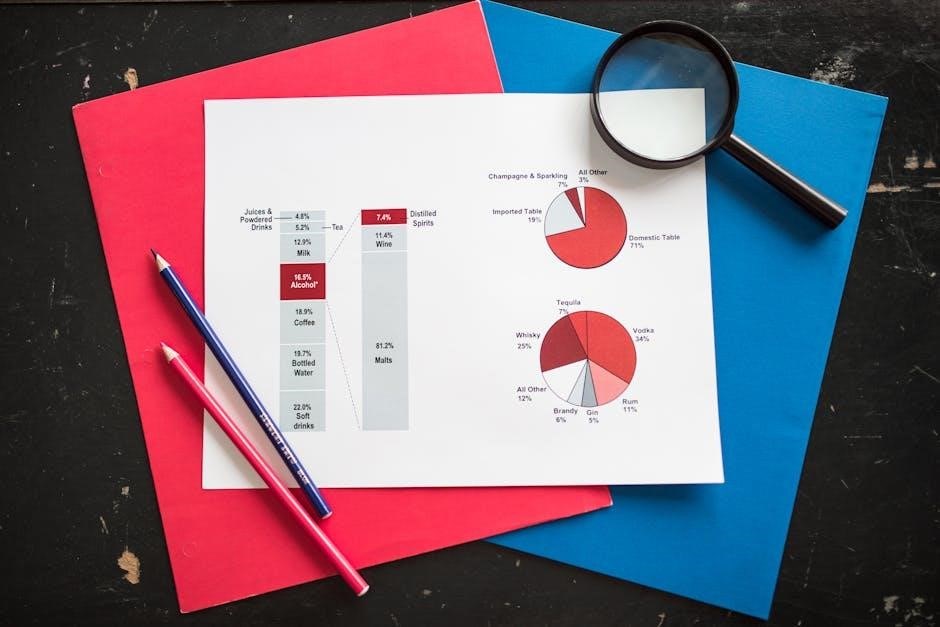
A robust cause and effect graphic organizer PDF isn’t limited to simply listing causes and effects; enriching it with supporting details is crucial. Utilize the text input fields to add specific evidence, statistics, or examples that substantiate each connection.
This could involve dates, names, or brief explanations that strengthen the analysis. For example, instead of just stating “Increased rainfall,” specify “Increased rainfall by 20% in July 2025.”
These details transform the PDF from a basic outline into a comprehensive and persuasive argument, enhancing its value for research, study, or presentation purposes.
Creating Hierarchical Relationships
Many complex scenarios involve causes that trigger other causes, ultimately leading to multiple effects. A well-designed cause and effect graphic organizer PDF allows for illustrating these hierarchical relationships.
Utilize the available space and connectors – often visual arrows – to demonstrate how one cause directly influences another, before both contribute to a final effect.
This layering of information clarifies complex systems, showing not just that things are connected, but how they are connected. Prioritize causes within the PDF, showcasing primary and secondary influences for a clearer understanding.